

TIK is involved in various research and development projects. Our role is often the implementation of new developments in real production environments. We have particular expertise in the areas of network architecture, communication systems, data security, software development, e-learning infrastructures and interfaces.
Basic data project bwOSLMS

Consortium partners
- University of Freiburg
- University of Heidelberg
- University of Hohenheim
- University of Mannheim
- University of Tübingen
- University of Ulm
- Karlsruhe Institute of Technology (KIT)
- University Network for the Digitization of Teaching in Baden-Württemberg (HND-BW)

bwOpenSource Learning Management Systems (bwOSLMS)
As part of the bwOpenSource Learning Management Systems (bwOSLMS) project and the “Future Lab: Universities in the Digital World” dialog process, two learning management systems, Moodle and ILIAS, will be sustainably developed moving forward. This project is a cooperation between Baden-Württemberg's universities and the Baden-Württemberg University Network for the Digitization of Teaching (HND-BW).
Basic data project SMiLE
Project duration
April 1, 2026, through March 31, 2028
SMiLe Project – Developing Teaching Through Making
Easily accessible digital fabrication methods such as 3D printing and laser cutting open up new opportunities for schools to integrate making into their teaching. Although these devices are now commonly available in schools, their use presents a challenge for teachers.
To ensure that teachers can use making technologies effectively in their teaching, it is important that they are fundamentally familiar with various processes, have already experimented with possible applications, and know which resources they can draw upon. The earlier future teachers are introduced to making, the better: that is why SMiLe—Developing Schools Through Making in Teacher Education.
Master’s students complete the new project-based making seminar of the Educational Sciences Companion Program shortly before their practicum semester, develop lesson plans on making, and test them in a school setting. In a new project-based seminar in the bachelor’s program, students acquire the foundational knowledge needed to prepare for teaching and learning through making. They can earn a making certificate that covers not only equipment operation but also aspects of makerspace design with a focus on diversity, equity, and inclusion.
SMiLe prepares prospective teachers to integrate “making” as a creative and technology-based method into their lessons and to develop Open Educational Resources (OER) for school instruction.
Project bwSFS-2
The bwSFS-2 (Baden-Württemberg Storage for Science 2) project, a research data storage system operated jointly by the universities of Stuttgart, Hohenheim, Tübingen and Freiburg, reached important milestones last year. The system will offer a newly developed storage management interface, fast central storage via the CIFS and NFS protocols and a globally accessible S3 long-term storage facility at four locations in Baden-Württemberg.
The project also aims to integrate research data management more easily into the research process and to comply with the FAIR data principles (Findable, Accessible, Interoperable, Reusable) through early and automatable metadating of the data. Special software is being developed by an external software company for this purpose. This will make it easier to identify valuable data and make it usable and understandable in the long term.
Media Center
Thanks to the generous support of the KSB Foundation, it will be possible to set up a media center in Universum/Pfaffenwaldring 45. The media center will enable all members of the university to implement teaching-related and private video and virtual reality projects with a training and operating concept similar to that of the makerspace. There will also be a motion capture area and a small recording studio as well as computer workstations with high-performance computers. The FiLL, S4S, digit@L and SDG-Campus projects will also benefit from the studio's facilities.
Completed projects
Open space projects (completed)
We were awarded project funding for three projects in the “Freiraum 2023” competition organized by the “Innovation in University Teaching” foundation.
4R: Repair - Reduce - Reuse - Reycle
The project uses student participation, a repair workshop in the makerspace and an accompanying course to promote awareness and knowledge of sustainability and encourage the development of creative solutions to sustainability challenges. It complements and expands the university's commitment to the SDGs (UN Sustainable Development Goals).
Research-based learning in the laboratory (FiLL)
FiLL brings frequently conducted experiments from the laboratories of the basic lectures into virtual reality. We test the use of VR in various teaching scenarios and develop new forms of exercises.
Students 4 Students
With the hypothesis that "students themselves know best where the typical comprehension problems lie", the S4S project enables interested students to create educational videos for their fellow students under professional guidance and with reviews by experts and to use them in university courses.
The projects will run for two years from April 2024. A total of €1,224568.40 in funding was raised.
Basic data: bwCampusnetz
Financed by:
Ministerium für Wissenschaft und Kunst Baden-Württemberg (MWK)
Project duration:
January 2023 - December 2025
Project status:
ongoing
Project partners:
Project details: bwCampusnetz
In the bwCampusnetz project, the universities of Karlsruhe (KIT), Constance, Mannheim, Stuttgart and Ulm are working together to examine the universities' campus networks with regard to their future viability. The aim is to find future-proof concepts and investigate and demonstrate their practical feasibility through prototype implementations.
The focus is on the further development of network architecture and network design, with a particular focus on segmentation, wireless LAN, VPN and firewall. A network of the future is to be measured by the quality characteristics of security, scalability, reliability, manageability and automation of the network. The existing networks are to be adapted to the growing requirements and the requirements of the BSI IT baseline protection.
The project builds on the successful collaboration in the bwIPv6@Academia project. The aim is to further strengthen the pioneering role already achieved with IPv6 throughout Germany in the area of campus networks.
TIK is responsible for the network access harmonization work package, in particular for the convergence of wired and wireless access networks with regard to IT security and administration.
Basic data digit@L
Financed by:
Project duration:
August 2021 - July 2024
Project partners:
The project is supported in terms of content and structure by a large number of facilities, institutes and teaching staff at the University of Stuttgart.
Project details: digit@L
“Digital teaching and learning at the University of Stuttgart. BOOST.SKILLS.SUPPORT”
The digit@L project focuses on students in the important first year of study and the target group-specific differentiation of basic courses in digital settings. Students are to be supported in their individual learning process in view of their heterogeneous prerequisites by means of digitally enriched teaching/learning formats and adaptive systems. At the same time, the university is specifically expanding the skills profile of students and lecturers through the closer integration of didactic and (media) technical infrastructure. The project is divided into three sub-projects: Digital BOOST for success and motivation in the first year of study (digitally enriched learning opportunities), Digital SKILLS for skills for the digital transformation (key skills for digital literacy) and Digital SUPPORT for infrastructure and service offerings (expansion of technical infrastructure and addition of innovative elements).
Basic data: bwIDM2
Financed by:
Ministerium für Wissenschaft und Kunst Baden-Württemberg (MWK)
Project duration:
August 2021 - December 2024
Project status:
ongoing
Project partners:
Project details: bwIDM2
bwIDM2 - Security & Communities
New edition of the identity management project
The state's universities provide a large number of distributed services and resources. These are offered to members via the access mechanisms developed in the bwIDM project. This federative identity management serves as a model for other federal states. The range of state services available today spans areas from HPC to data and resource management to online courses. The services have successively defined requirements for the central software platform, which has been expanded by many functionalities since the end of the project.
The bwIDM2 project is dedicated to the increased requirements for IT security and takes current technical developments into account. It creates the prerequisites for the integration of services across all higher education institutions and establishes a group/role administration for supra-regional and national communities with delegation mechanisms. In addition, specialist concepts for the integration of a long-term personal identifier in bwIDM, as required for use in research data management, are being developed.
Project website https://www.bwidm.de/bwidm2.php
Basic data bwILIAS
Financed by:
Ministerium für Wissenschaft, Forschung und Kunst (MWK)
Project duration:
October 2021 - September 2024
Project partners:
- Universität Hohenheim
- Universität Freiburg
Project details: bwILIAS
Strengthening open source software for university teaching
The bwILIAS project concentrates on optimizing the ILIAS learning platform in three focus areas
● Expansion and extension of ILIAS as a digital examination system with a view to the special features and workflows of the university examination cosmos
● Provision and further development of interfaces to other learning platforms and for linking other relevant university IT systems
● Sustainably maintaining and ensuring the stability and quality of the ILIAS program code through refactoring and urgent bug fixes
Basic data PePP
Financed by:
Project duration:
August 2021 - July 2024
Project partners:
- Universität Heidelberg
- Universität Hohenheim
- Universität Freiburg
- KIT Karlsruher Institut für Technologie
- Universität Konstanz
- Universität Mannheim
- Universität Tübingen
- Universität Ulm
- An der Universität Stuttgart intern:
- Institut für Erziehungswissenschaft
- ZLW
Project details: PePP
Partnership for innovative e-exams
With “PePP”, all Baden-Württemberg universities are jointly pursuing the goal of systematically tapping into the previously untapped potential of electronic examinations for students and teachers and making existing experience more widely available. Electronic examinations have become increasingly relevant during the coronavirus pandemic. The task now is to transform successful approaches into sustainable solutions.
With “PePP”, technical and didactic innovations are being (further) developed in real-world laboratories and rolled out at several universities, tested under various technical, infrastructural and organizational conditions and further developed and scaled in a quality-oriented manner. The aim is to strengthen competence orientation, increase mobility and flexibility and make examinations more learner-centered. Cross-sectional clusters provide impulses for university didactics, support the qualification of teachers and generate feedback on the quality of e-exams.
Basic data MakEd_digital
Financed by:
Bundesministerium für Bildung und Forschung (Qualitätsoffensive Lehrerbildung)
Project duration:
2020 - 2023
Project details: MakEd_digital
Make Education digital
The project aims to develop the digitalization-related skills of (future) teachers to use, develop and reflect on digital media and tools in teaching and learning contexts. We want to increase these skills by establishing pedagogical-didactic makerspaces at the partner universities. In the makerspaces, students and teachers on teacher training courses receive support in the creation, use and reflection of digital materials in the classroom. Helpful expertise is provided by employees with backgrounds in media technology, pedagogy and didactics, educational science and subject didactics.
Project details: SusI
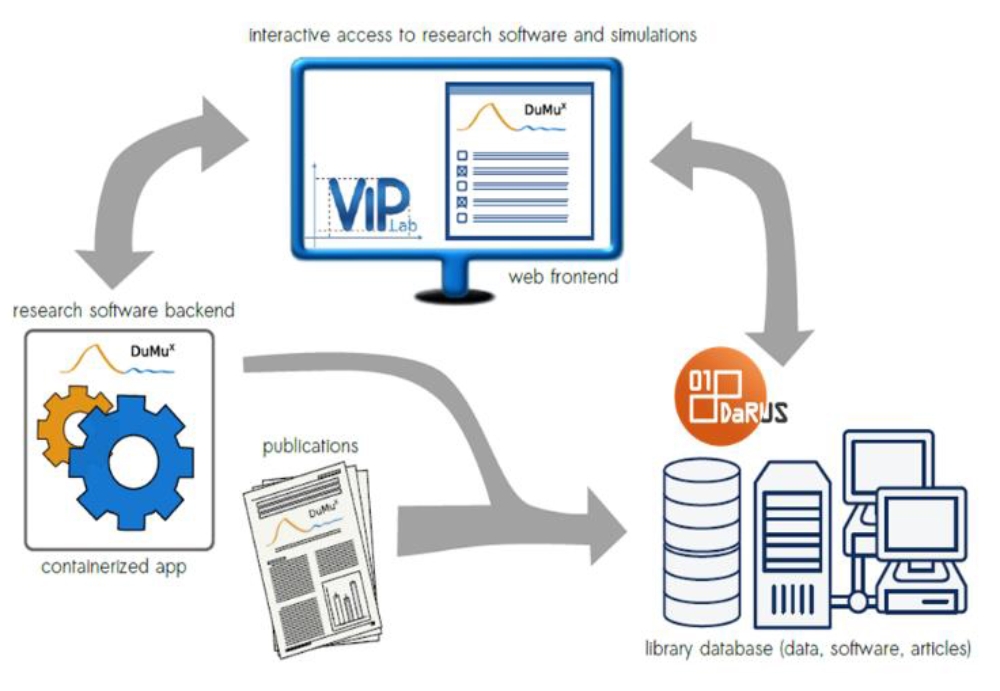
SusI stands for Sustainable infrastructure for the improved usability and archivability of research software on the example of the porous-media-simulator DuMux. The aim of the SusI project is to make the open source simulation software DuMux available to a wider circle of scientists. In addition, the knowledge gained through the use of DuMux, together with the source code, is to be stored, accessed and reused in the research data management system of the University of Stuttgart.
Basisdaten VipLab
Finanziert durch:
Universität Stuttgart
Projektstatus:
abgeschlossen, in regulären Dienst überführt
Weitere Informationen:
Project details: ViPLab
Virtual Programming Lab
The ViPLab development project includes a browser-based programming environment, computing backends on TIK servers, and a communication middleware. Originally initiated by students and funded by tuition fees, ViPLab has been actively used in teaching since 2010. The integration of practical tasks into engineering education, e.g., through the use of complex simulation software, as well as a unified programming environment for practice and exam situations are the goals and advantages of ViPLab.
In addition to operating ViPLab as a service, its components are actively being further developed. For example, a student project is currently working on converting the computing backends to a modern container architecture. Furthermore, the SusI project is developing a new use case: the executability of software for a scientific publication with the help of ViPLab.
Basic data AduLeT
Financed by:
EU program Erasmus+
Project duration:
completed
Project partner:
- PH Ludwigsburg
- HUMAK University of Applied Sciences
- Open University Netherlands
- Polytechnic Institute of Bragança
- Complutense University of Madrid
- John von Neumann University
- TU Delft
- Pixel
Project website:
Project details: AduLeT
The three-year EU project AduLeT (Advanced Use of Learning Technologies in Higher Education) aims to identify obstacles to the use of e-learning in university teaching and to develop measures to overcome these obstacles.